
Hard water in Taylor County is actively shortening the life of your refrigerator right now, whether you can see it or not. If your ice maker has slowed down, your water dispenser trickles instead of flows, or your fridge seems to be working harder than it used to, the water coming through your supply line is very likely the reason. This is not a minor inconvenience. It is a slow, silent form of appliance damage that costs Abilene homeowners hundreds to thousands of dollars in premature repairs and replacements every year.
At Falcon Appliance Services, we see the damage hard water causes to refrigerators across Abilene, North Abilene, Wylie, Elmwood, Potosi, and surrounding communities daily. What makes Taylor County especially challenging is that our water is not just hard. It sits firmly in the very hard category, and that distinction matters enormously when you are trying to protect an appliance that runs every single day of the year.
What Makes Abilene Water So Hard?
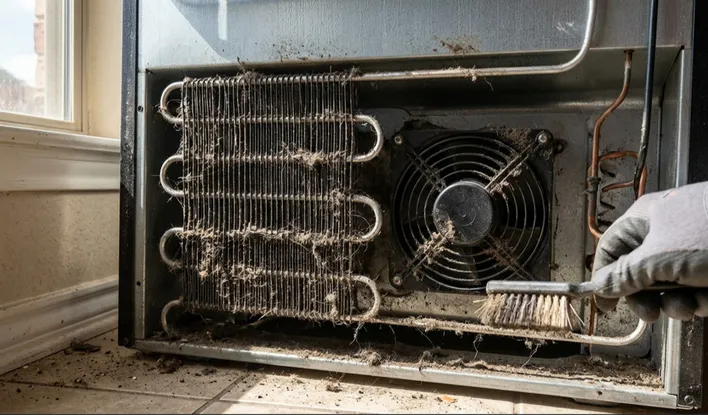
The City of Abilene draws its water supply from sources including Elm Creek Reservoir and underground aquifers that pass through ancient limestone and gypsum formations. Those geological layers have been dissolving calcium and magnesium into the water supply for millions of years. By the time water reaches your home, it carries a significant mineral load.
According to the City of Abilene’s own water utility FAQ, the water hardness averages around 240 milligrams per liter of calcium carbonate, which works out to approximately 14 grains per gallon. Water quality organizations classify anything above 10.5 grains per gallon as very hard. That means Abilene sits well above the threshold where appliance damage becomes a predictable outcome rather than a possibility.
To put that in perspective, water is generally considered hard starting at 7 grains per gallon, and experts recommend keeping water hardness below 7 grains per gallon to avoid meaningful damage to household appliances. Abilene’s average is double that of the recommended maximum.
Every time your refrigerator draws water through its supply line, whether to fill the ice tray or dispense a glass of water, it is pulling in water loaded with dissolved calcium and magnesium. Those minerals do not stay dissolved. When water slows down, heats up, or freezes, the minerals drop out of solution and coat everything they touch with a chalky, hard mineral scale called limescale or calcium carbonate scale. Inside a refrigerator’s water system, there is nowhere for that scale to go except deeper into the components.
The 5 Ways Hard Water Destroys Your Refrigerator in Taylor County
1. The Water Inlet Valve Clogs and Eventually Fails
The water inlet valve is the small component that controls the flow of water from your home’s supply line into the refrigerator. It opens to allow water into the ice maker and water dispenser, then closes to stop the flow. Inside that valve is a screen filter and a small solenoid mechanism, and the opening through which water flows is only about one-sixteenth of an inch in internal diameter.
That tiny opening is exactly why hard water causes so much trouble. As mineral scale accumulates inside the valve and on its screen filter, water flow slows progressively. You may notice your water dispenser taking longer to fill a glass, or your ice maker producing smaller, hollow, or malformed cubes. Eventually, the valve may stick partially open, causing a slow drip into the refrigerator that you never see until water pools under the unit or soaks the internal insulation. In other cases, scale buildup prevents the valve from opening at all, stopping ice and water production completely.
Research on appliance longevity in hard water conditions suggests that refrigerator water inlet valves in hard water homes often need replacement within three to five years, compared to eight to ten years in homes with treated water. In Abilene, where hardness levels are well above average for even Texas, which itself has some of the hardest water in the country, the damage timeline can be even shorter.
Replacing a water inlet valve typically costs between $150 and $300, including labor. That is a repair. Many Abilene homeowners face multiple times over the life of a single refrigerator.
2. The Ice Maker Clogs, Slows, and Stops
The ice maker is essentially a miniature water treatment and freezing system inside your refrigerator, and it is the component most visibly impacted by hard water. Here is what happens in hard water conditions.
When water enters the ice tray and begins to freeze, the minerals dissolved in that water cannot freeze along with the water molecules. They get pushed to the outside of the ice crystal as it forms. That process leaves mineral deposits on the evaporator plate, the float switch, the water tray, and the internal walls of the ice maker compartment. Over time, that scale accumulates layer by layer.
The results are visible and progressive. First, you may notice your ice cubes look cloudy or white rather than clear. Clear ice forms when water is very pure and freezes slowly from the outside in. Cloudy ice indicates high mineral content being pushed to the center of the cube during formation. Next, the cubes may become smaller, partially hollow, or irregularly shaped as mineral deposits interfere with the freezing cycle. Eventually, scale buildup on the float switch causes it to misread water levels, and scale on the evaporator plate reduces heat transfer efficiency, so the water freezes incompletely.
If the ice maker is not serviced and descaled, the mineral accumulation can cause the unit to stop producing ice entirely. At that point, the homeowner is often looking at ice maker replacement rather than simple cleaning and maintenance. Ice maker replacement in a modern French door or side-by-side refrigerator typically runs between $250 and $500, including parts and labor.
Beyond the ice maker mechanism itself, mineral deposits from hard water can also cause ice cubes to carry an off-taste. If you have ever noticed that filtered water from your refrigerator tastes fine, but the ice has a flat or slightly mineral flavor, the scale building up in the ice maker is the cause.
3. Scale Builds Up in the Water Lines and Restricts Flow
Your refrigerator’s water system includes tubing that runs from the wall connection behind the refrigerator through to the ice maker and water dispenser. In Abilene’s very hard water conditions, calcium and magnesium scale begin accumulating inside those lines from the first day the refrigerator is connected.
Unlike the visible scale you see on faucets or in the toilet bowl, the scale inside refrigerator water lines is hidden inside tubing you cannot inspect without moving and partially disassembling the appliance. It builds silently, narrowing the effective diameter of the line over months and years. As the line narrows, water pressure at the ice maker and dispenser drops. The dispenser slows. Ice production drops. Eventually, a line can become so restricted that the water inlet valve, which is calibrated to expect a certain pressure and flow rate, begins operating erratically.
In some cases, a thick section of mineral scale can break loose and travel through the water system, lodging in the valve screen or dispenser nozzle and causing a sudden, complete blockage. This is one of the more disruptive outcomes of long-term hard water exposure because it looks to the homeowner like the refrigerator suddenly stopped working, when, in reality, the damage has been building for years.
Flushing and inspecting refrigerator water lines should be part of a standard maintenance routine in Taylor County, and it is something Falcon Appliance Services technicians check during every refrigerator service call.
4. The Water Dispenser Nozzle and Tray Develop Scale and Clogs
The external water dispenser is the most visible place where hard water damage shows itself. That chalky white or yellowish crust that forms around the dispenser nozzle and in the drip tray is calcium carbonate scale, the same mineral deposit that accumulates invisibly inside the system.
On the outside, scale is mostly a cosmetic issue you can address with a vinegar solution and a cloth. But inside the dispenser nozzle itself, scale can gradually narrow the opening and change the flow pattern of the water. A dispenser that once produced a strong, straight stream may begin to spray sideways, drip, or dribble slowly. In some refrigerator models, a scale inside the dispenser housing can cause the actuator mechanism to stick, resulting in a dispenser that runs continuously or fails to activate.
On a practical level, mineral staining around the dispenser is also a sign that the same process is happening inside components you cannot see. When the outside looks scaled up, the inside has usually been built for much longer.
5. Hard Water Accelerates Overall Refrigerator Wear and Increases Energy Costs
This is the part that most homeowners in Taylor County do not think about until they get an unusually high electricity bill. Every component in your refrigerator’s water system that is partially clogged or working against mineral resistance requires more energy to perform its function.
A water inlet valve that is partially scaled has to work harder to open and close correctly. A compressor that has to run longer cycles because the ice maker is struggling to maintain production puts more strain on the entire sealed cooling system. The relationship between hard water damage to water components and compressor wear is not always obvious, but it is real. An ice maker that is working inefficiently forces longer compressor run times, and longer compressor run times accelerate wear on the motor, the condenser, and the evaporator.
Research in this area consistently shows that hard water can reduce the lifespan of major appliances by 30 to 50 percent and increase energy consumption by as much as 29 percent compared to appliances operating with treated water. For a refrigerator that might otherwise last 15 years in soft water conditions, very hard water exposure in Abilene could realistically cut that to 8 to 10 years without proper maintenance and protection.
When you add up the cost of multiple inlet valve replacements, an ice maker replacement, and a shortened overall appliance lifespan, the financial case for protecting your refrigerator from hard water damage becomes very clear.
How to Tell If Hard Water Is Damaging Your Refrigerator Right Now
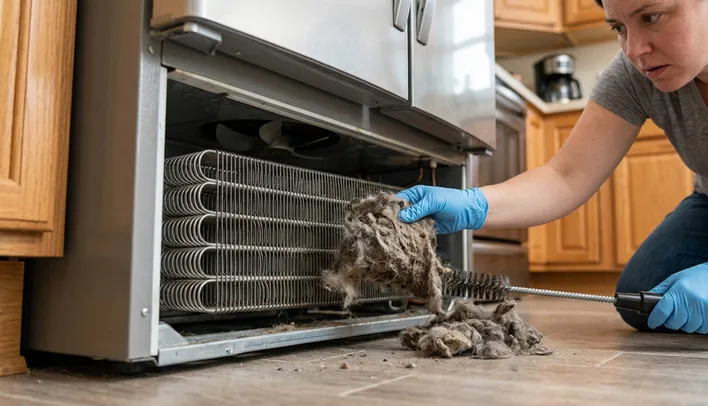
You do not have to wait for a complete failure to recognize that hard water is affecting your refrigerator. Here are the signs that indicate the damage is already underway.
Your ice cubes are cloudy, hollow, smaller than they used to be, or have an off taste. This is almost always a hard water issue in Taylor County.
Your water dispenser is slower than it was when the refrigerator was new. If filling a 16-ounce glass takes noticeably longer than it once did, mineral scale is likely restricting the water line or inlet valve.
There is white or chalky buildup around the dispenser nozzle or in the drip tray. This visible scale is a reliable indicator that the same process is happening internally.
Your refrigerator filter needs replacing more frequently than the manufacturer recommends. Filters in very hard water conditions become saturated with mineral content faster than the schedule assumes.
You hear the ice maker cycling more frequently without producing more ice, or you hear it cycling without producing ice at all.
Water pools under the refrigerator with no obvious external source. A water inlet valve that has been partially damaged by scale may not close fully, allowing a slow drip that eventually reaches the floor.
What You Can Do to Protect Your Refrigerator in Abilene
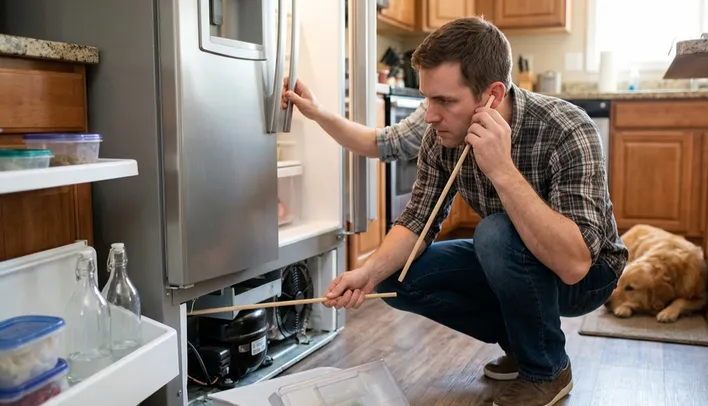
Change Your Refrigerator Water Filter Every 3 to 4 Months, Not Every Six
Most refrigerator manufacturers recommend changing the built-in water filter every six months. That recommendation is based on average national water conditions. Abilene’s water hardness is well above average, which means your filter reaches its effective capacity faster than the six-month guideline assumes.
A saturated filter stops removing contaminants effectively and can even begin releasing captured minerals back into the water. In Taylor County, changing the filter every three to four months is a more appropriate schedule. Check your model’s owner’s manual for the specific filter type, and set a recurring reminder on your phone so it does not slip.
It is also important to understand what your refrigerator filter does and does not do. Most built-in refrigerator filters are certified to reduce chlorine taste and odor and certain contaminants. They are not water softeners. They do not remove calcium and magnesium from the water. Hard water minerals pass right through a standard refrigerator filter and continue accumulating in the water lines, inlet valve, and ice maker. A filter keeps the water tasting clean, but it does not prevent mineral scale damage.
Descale the ice maker every 6 months.
Descaling is the process of using an acidic solution, typically food-grade citric acid or plain white vinegar, to dissolve accumulated mineral scale inside the ice maker. Many refrigerator manufacturers include descaling instructions in the owner’s manual, and the process can be done without any special tools.
In very hard water areas like Taylor County, twice-yearly descaling is appropriate. This removes the mineral buildup before it can accumulate to the point where it interferes with ice production or damages the float switch and evaporator plate.
After descaling, always discard the first two or three batches of ice to ensure no descaling solution residue remains in the system.
Flush the waterline annually.
Once a year, having a technician flush and inspect your refrigerator’s water supply line removes loose scale and sediment before it can travel into the valve or dispenser. This is a quick-service task that prevents the more expensive consequences of line blockage.
If you have not had this done since your refrigerator was installed and it is more than three years old, scheduling a maintenance visit before a problem develops is significantly less expensive than an emergency repair call when the ice maker or dispenser fails.
Wipe the dispenser area weekly.
Keeping the dispenser nozzle and drip tray clean is not just cosmetic maintenance. The mineral scale that accumulates externally will eventually work its way back into the nozzle opening if left unchecked. A damp cloth dampened with a diluted white vinegar solution, used weekly on the dispenser nozzle and tray, dissolves fresh scale before it hardens and requires more aggressive treatment.
Avoid applying vinegar directly to any stainless steel surfaces on your refrigerator, as prolonged exposure can affect the finish.
Consider a whole-house water softener or an inline filter.
This is the most comprehensive solution to the problem and the only approach that actually removes calcium and magnesium from the water before it enters any of your appliances. A whole-house water softener uses an ion exchange process to swap calcium and magnesium ions with sodium ions, producing water that does not form limescale in pipes, valves, or appliances.
The investment is meaningful, typically running between $800 and $2,500 for a whole-house system including installation, but the return in extended appliance life, reduced repair frequency, and lower energy costs is substantial for Taylor County homeowners dealing with very hard water.
If a whole-house system is not in the budget, an inline filter installed on the refrigerator supply line specifically is a more targeted and affordable option. These filters are designed to reduce mineral hardness in the water feeding the refrigerator and typically cost between $50 and $150 for the filter unit plus installation.
Frequently Asked Questions
Does a refrigerator water filter remove hard water minerals? No. Standard refrigerator water filters reduce chlorine, sediment, and some contaminants, but they do not soften water or remove calcium and magnesium. Hard water minerals pass through the filter and continue causing scale damage inside the ice maker and water lines.
How long should a refrigerator last in Abilene with hard water? Without protective maintenance, very hard water conditions like those in Taylor County can reduce a refrigerator’s effective lifespan by 30 to 50 percent compared to soft water conditions. A refrigerator that might last 15 years with treated water could experience significant component failures in 8 to 10 years when exposed to hard water without proper maintenance.
Why does my ice taste bad even though my filter is new? If the filter is new but the ice still has an off taste, mineral scale that has built up inside the ice maker over time is the likely cause. Descaling the ice maker will usually resolve this issue.
Can I fix a clogged water inlet valve myself? The water inlet valve can be replaced by a homeowner with basic appliance repair knowledge, but it requires shutting off the water supply, disconnecting the refrigerator, and working with electrical connections. In most cases, having a licensed technician perform the replacement ensures the job is done correctly and does not void any remaining warranty coverage.
How do I know if my refrigerator water line is clogged with scale? Slow water flow from the dispenser and reduced ice production are the primary signs. A technician can check water pressure at the refrigerator’s inlet to confirm whether a clogged line or valve is the source of the restriction.
Refrigerator Repair and Maintenance in Abilene, TX
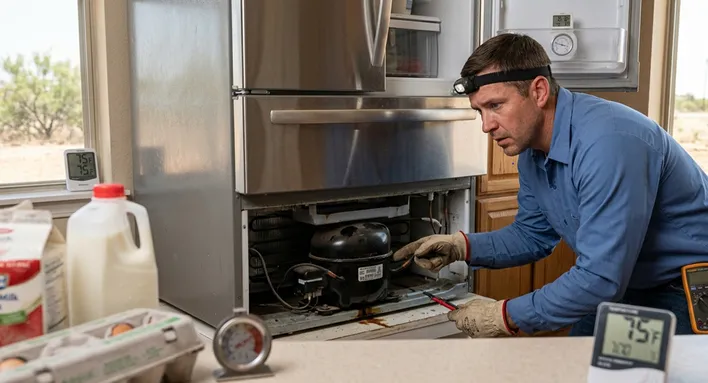
If you are experiencing slow ice production, a sluggish water dispenser, cloudy ice cubes, or water pooling under your refrigerator, hard water damage is the most likely explanation, and it is a problem that gets more expensive the longer it is left unaddressed.
Falcon Appliance Services provides refrigerator repair, maintenance, and descaling service throughout Abilene and Taylor County, including North Abilene, South Abilene, East Abilene, West Abilene, Wylie, Elmwood, Potosi, Buffalo Gap, Chimney Rock, Fairway Oaks, and surrounding communities. Our licensed and insured technicians understand the specific challenges that West Texas hard water creates for household appliances, and we carry the parts needed to address the most common hard water-related failures in a single visit.
Every repair we perform is backed by a warranty on parts and labor, and we provide transparent pricing before any work begins.
Call us at (325) 399-6710 to schedule a refrigerator service or maintenance visit. We are available 24 hours a day, 7 days a week, for emergencies where an ice maker or water system failure cannot wait.
Falcon Appliance Services proudly serves Abilene, TX, and the surrounding Big Country area. Licensed, insured, and experienced in the appliance challenges unique to West Texas.