
Cleaning refrigerator condenser coils in West Texas is not optional maintenance. It is survival maintenance. If you live in Midland, Odessa, Lubbock, Amarillo, or anywhere across the Permian Basin and the Southern High Plains, your refrigerator is working against conditions that most appliance manufacturers never fully account for. The dust storms here are not a minor inconvenience. They are a documented, recurring environmental force that coats your condenser coils in a thick layer of caliche dust and debris far faster than the standard “clean every six months” advice would suggest.
This guide walks you through exactly how to clean refrigerator condenser coils under West Texas conditions, how often you actually need to do it out here, and what happens to your compressor and your electric bill when you skip this task.
Why West Texas Dust Is a Uniquely Serious Problem for Your Refrigerator
Before getting into the how, it helps to understand the why at a level specific to this region.
A study analysing dust events from 2000 to 2020 identified a total of 1,834 dust events across four West Texas locations, with an average of 22 dust events per year. Lubbock recorded 609 dust events, and Midland recorded 545 events over those 20 years. That works out to roughly one significant dust event every week or two during active seasons.
The Southern High Plains in West Texas experience multiple dust events annually due to surrounding agriculture as well as the Chihuahuan Desert to the west. When those winds pick up, gusts between 60 and 75 mph generate walls of dust with near-zero visibility. That same particulate matter flows right through the gaps around your kitchen cabinetry and settles into every open surface in your home, including the condenser coils sitting beneath or behind your refrigerator.
The condenser coils are designed to release heat generated from inside the refrigerator. When these coils are covered in dust, dirt, or debris, they cannot carry out this function efficiently, and the overall temperature of the refrigeration system increases. As a result, the compressor has to work harder and run more frequently to maintain the desired internal temperature.
In a climate where summer temperatures already push past 100 degrees Fahrenheit for weeks at a stretch, a coil clogged with West Texas caliche is essentially asking your refrigerator to sprint a marathon in the middle of July. Something eventually gives.
What Happens When You Ignore the Coils
People often assume a refrigerator will just keep running until it does not. That assumption is expensive out here. Here is what is actually happening inside your appliance when the condenser coils go uncleaned through a full West Texas dust season.
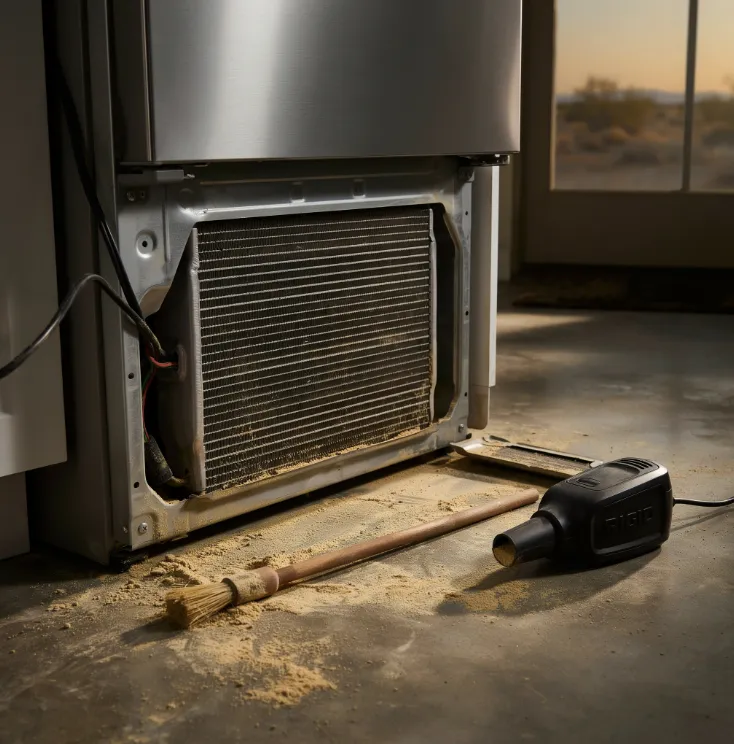
When the condenser coils are covered in dust, the compressor has to work overtime to achieve the same cooling effect. This not only increases wear and tear on the compressor but can also lead to overheating. In severe cases, this can cause the compressor to fail, resulting in an expensive appliance repair bill.
A sudden increase in energy bills can be a telltale sign of compressor overheating. If your refrigerator is failing to maintain the proper temperature and food is spoiling more quickly than usual, the compressor might be struggling to keep up.
Under normal conditions, a refrigerator compressor typically runs between 120 and 140 degrees Fahrenheit. Temperatures above 150 degrees indicate a potential overheating issue that needs immediate attention.
Most modern refrigerators use fans to circulate air over the condenser coils and keep them cool. Dust can accumulate on the fan blades, reducing their efficiency and causing the motor to strain.
The short version: dirty coils lead to a hot compressor, a hot compressor leads to higher electricity bills and shortened appliance life, and out here in West Texas, it can happen within weeks of your last cleaning if a big haboob blows through.
Tools You Will Need Before You Start
Getting the right tools together before you pull the refrigerator out saves time and gets the job done the first time properly. Here is what you need:
A coil cleaning brush, which is a long, narrow, flexible bristle brush specifically designed to fit between condenser coil fins. A vacuum cleaner with a crevice tool attachment. A flashlight for seeing into dark, low spaces. A screwdriver for removing access panels if your model requires it. Compressed air in a can, which is especially helpful for West Texas conditions, where fine caliche dust packs into tight spaces. A microfiber cloth for cleaning the floor area and surrounding surfaces once the dust is loosened. Safety glasses are a smart addition when you are dealing with the level of dust accumulation common in this region.
Where Are the Condenser Coils on Your Refrigerator?
The condenser coils are typically located at the back or bottom of the refrigerator. Some units may have access panels that need to be removed to reach the coils.
On most modern refrigerators, including popular brands like Whirlpool, LG, Samsung, GE, Frigidaire, KitchenAid, Maytag, and Bosch, the coils sit beneath the unit behind a removable toe grille at the front bottom. On older models and some specific configurations, the coils run across the back of the unit. If you are unsure, check your owner’s manual or look up your model number online before you start moving anything.
Step by Step: How to Clean Refrigerator Condenser Coils in West Texas Dusty Conditions
Step 1. Cut the Power First
Unplug the refrigerator or switch off the circuit breaker before cleaning. Do not disturb water lines for ice or water dispensers, wear safety glasses, and avoid bending fins or tubing. This step is non-negotiable. You are working near the compressor and electrical components, and with the level of dust buildup common in West Texas homes, you do not want any surprises.
Step 2. Pull the Refrigerator Away from the Wall
Even if your coils are located at the front bottom, pulling the unit forward gives you better access and lets you assess how much dust has accumulated on the back of the unit and on the floor beneath it. Go slowly to avoid scratching the flooring or kinking any water lines connected to an ice maker or water dispenser.
Step 3. Remove the Access Panel or Toe Grille
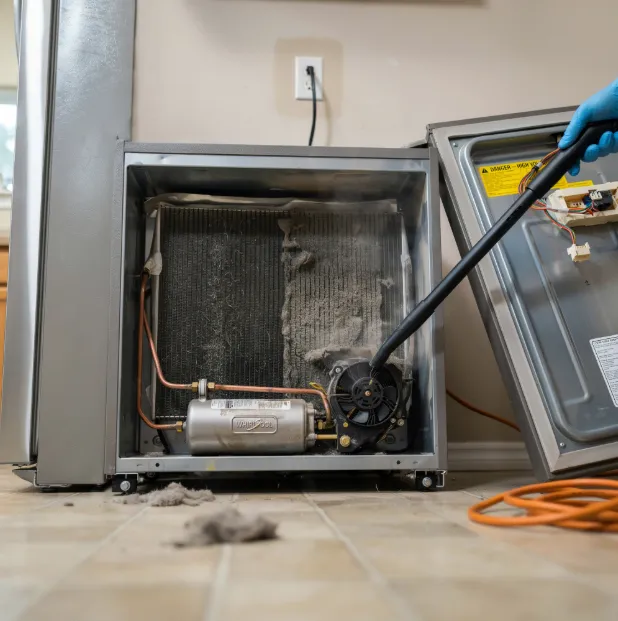
Remove the base grille at the bottom of the refrigerator by opening both doors, placing your hands along the ends of the grille, and pushing in on the top while pulling up on the bottom. Some models use screws. Set the grille aside and use your flashlight to get a clear look at what you are working with. In West Texas homes that have gone through a dust season without maintenance, what you see at this stage is often alarming.
Step 4. Vacuum First to Remove Loose Accumulation
Before you touch the coils with a brush, use the crevice tool on your vacuum to pull out the bulk of loose dust and debris. Remove as much dust as possible, ensuring the full area of the heat exchanger has been cleaned. You may want to alternate between brushing the coils and vacuuming the disturbed dust. In West Texas conditions, this first pass will pull out more material than you likely expect.
Step 5. Work the Coil Brush Through the Fins
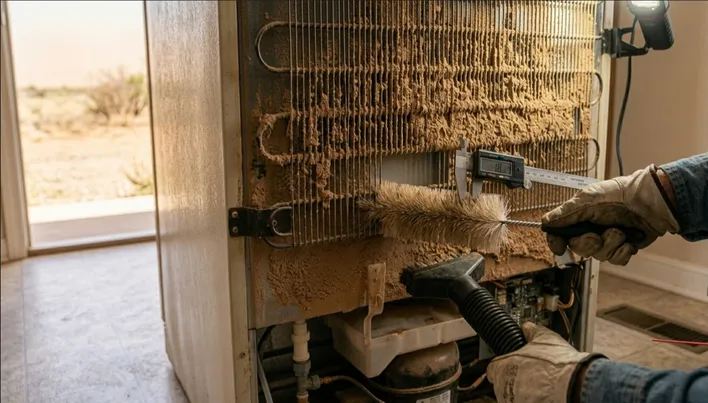
Push a coil brush into the condenser coils. The coil brush knocks the dust off the coils. After knocking the dust from the coils with a coil brush, vacuum the dust. Work in long, straight strokes that follow the direction of the fins. Never scrub across the fins at an angle, as this can bend them and restrict airflow even further. In West Texas situations where caliche dust has hardened between the fins, you may need to work the brush back and forth several times on the same section.
Step 6. Follow Up with Compressed Air
This is the step that most standard cleaning guides skip, but it matters specifically in West Texas conditions. Fine caliche particles pack into the narrow spaces between coil fins in a way that a brush alone cannot fully dislodge. A short burst of compressed air directed along the fins, followed immediately by vacuuming, pulls out the embedded particulate that would otherwise stay in place and continue restricting airflow.
Step 7. Vacuum the Floor Beneath and Behind the Unit
Once the coils themselves are clean, vacuum the floor area beneath the refrigerator thoroughly. This area collects enormous amounts of dust in West Texas homes, and if you push the unit back in without cleaning it, your fan will simply recirculate that material right back into the freshly cleaned coils.
Step 8. Clean the Condenser Fan Blades
While you have access, take a moment to wipe down the condenser fan blades with a dry microfiber cloth. Dust can accumulate on the fan blades, reducing their efficiency and causing the motor to strain. In a dusty environment, this is a step worth doing every time you clean the coils.
Step 9. Replace the Panel and Restore Power
Snap the toe grille back into place, confirm no tools or clothes are left underneath the unit, slide the refrigerator back against the wall with appropriate clearance, and plug it back in. Make sure there is at least 2 inches of space behind and around your refrigerator to help it cool properly.
How Often Should You Clean Condenser Coils in West Texas?
The standard industry recommendation is every six to twelve months. That schedule was written for average conditions. West Texas is not average.
A slight increasing trend of dust events over time was observed for Amarillo, Lubbock, and Midland, with most events occurring during the spring to early summer months. Given that pattern, here is a practical West Texas-specific cleaning schedule:
Every three months, if you live in Midland, Odessa, or any area close to open land or active agricultural fields. Every four months, if you live in a more urban setting in Lubbock, Amarillo, or Big Spring. After any major dust storm or haboob, regardless of when you last cleaned. If you have pets that shed, add one additional cleaning cycle per year on top of whatever schedule you follow.
Signs Your Coils Need Cleaning Right Now
You do not always have to wait for a scheduled date. Your refrigerator will usually tell you when the coils have reached a critical level of buildup. Watch for these signals:
Signs of an overheating fridge include loud operation, food not staying cold enough, and excessively hot external surfaces.
A refrigerator that runs constantly without pause can indicate a problem. Not only does this increase your energy bills, but it also puts unnecessary strain on the appliance, potentially leading to costly repairs.
A noticeable spike in your electricity bills can be a sign of a compressor working harder than it should.
If your freezer section feels slightly warmer than usual or your ice cream has been softer than normal, check the coils before assuming any other component has failed.
Preventing Rapid Buildup Between Cleanings
There are a few practical steps that slow the pace at which dust accumulates on your coils in West Texas conditions.
Keep the area directly beneath and behind your refrigerator swept or vacuumed regularly. Dust that settles on your kitchen floor is the primary source of what eventually gets pulled into the coil area by the condenser fan. Make sure your kitchen is reasonably well sealed. Check door sweeps and window seals, particularly after high-wind events. A home that lets in a lot of outdoor air during dust storms will accumulate coil buildup significantly faster. Avoid storing items on top of or directly behind your refrigerator, as these create turbulence patterns that can actually draw more dust toward the coil intake area.
When to Call a Professional
Most condenser coil cleaning is genuinely DIY-friendly if you have the right tools and are comfortable moving your appliance. But there are situations where it makes more sense to bring in a certified appliance technician.
If you inspect the coils and notice that the fins are visibly bent or damaged in large sections, cleaning alone will not restore proper airflow, and a technician may need to comb the fins back into alignment. If after cleaning you still notice the compressor running hot, the refrigerator cycling constantly, or food not staying properly cold, there may be a secondary issue such as a failing condenser fan motor, a refrigerant problem, or a faulty thermostat that cleaning will not resolve. If the coil buildup has gone multiple seasons without attention and the compressor has already been running hot for an extended period, a professional assessment can tell you whether the compressor itself has sustained damage.
The team at Falcon Appliance Services works with refrigerators across West Texas and understands exactly what this environment does to appliance components over time. If your condenser coils are beyond a DIY clean, or if cleaning them did not resolve the performance issues you were seeing, a professional service call can diagnose the underlying cause quickly and get your refrigerator back to running efficiently before the summer heat turns the situation critical.
The Bottom Line
Cleaning refrigerator condenser coils is the single most impactful piece of maintenance most homeowners never do. In West Texas, where dust events are a year-round reality and summer temperatures push your refrigerator to its limits, this task moves from routine to essential. Do it every three months. Do it after every major dust storm. Use the right brush, vacuum thoroughly, and follow up with compressed air to handle the fine caliche that packs into places a brush cannot fully reach.
Your refrigerator’s compressor will run cooler, your electric bill will reflect the improved efficiency, and your appliance will last significantly longer. That is a worthwhile return on twenty minutes of maintenance.